
Article5 min read
Technological Sovereignty: The Freedom to Choose
Technological sovereignty is not about rejecting foreign providers. It is about retaining the ability to choose, migrate, audit, and operate critical systems.
Read article →What we're thinking, plus tools and ideas to help you find your footing in the digital world.
Technological sovereignty is not about rejecting foreign providers. It is about retaining the ability to choose, migrate, audit, and operate critical systems.
Read article →
A second brain can save repeated explanations, prevent conflicting decisions, and make better use of your tokens. Here's how to start simple and when to add more capable tools.
Read article →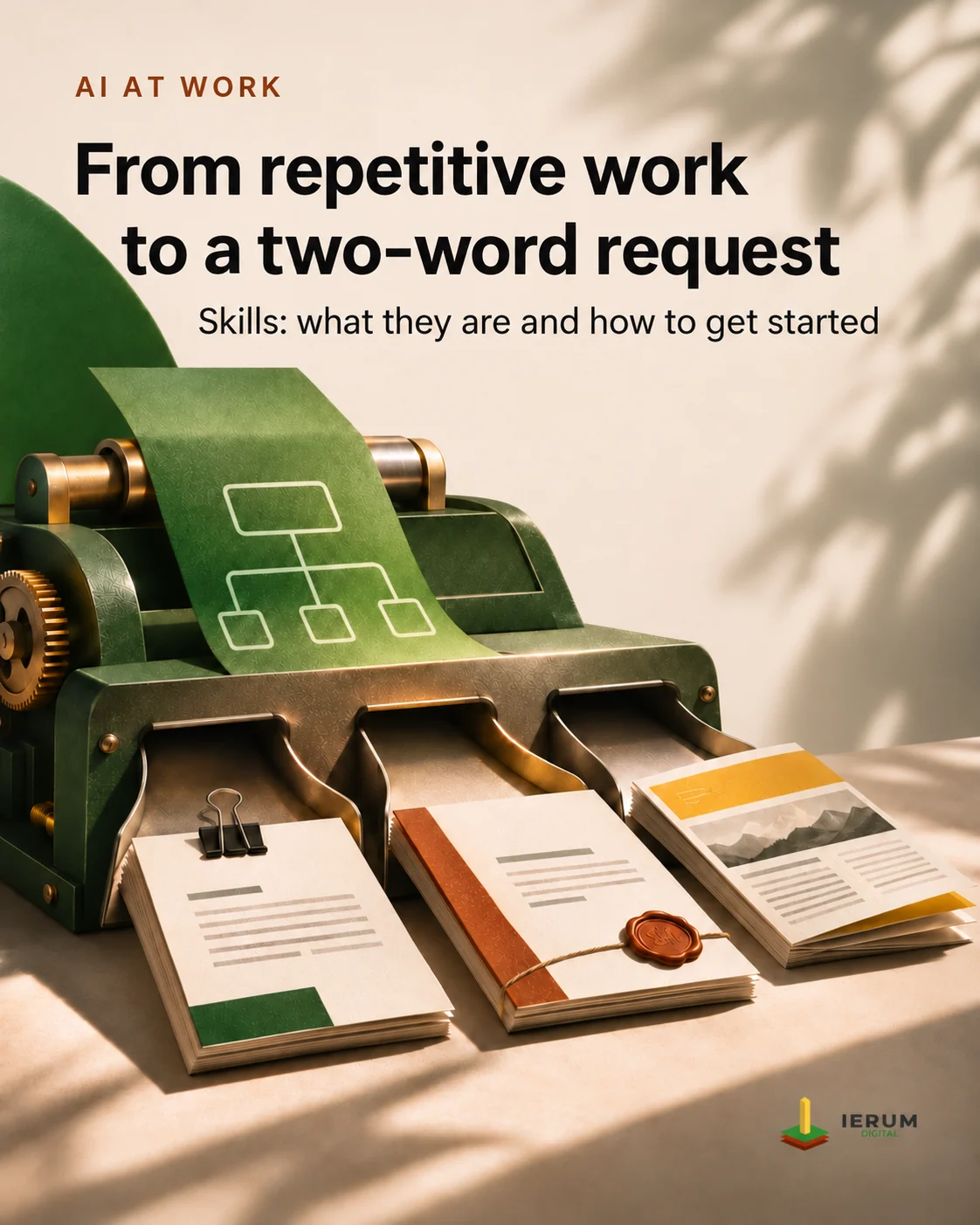
Learn how AI skills turn recurring work into reusable processes, with a simple example that selects different templates for internal messages, client communications, and newsletters.
Read article →
AI asks us to describe tasks we learned to perform almost automatically. That challenge could help us better understand and communicate what we need.
Read article →
Before adding another platform, see how it will work with the tools you already use—and how to catch discrepancies between orders, inventory and invoicing.
Read article →
MCP can expose controlled operations so AI agents can manage website content without replacing the backend, permissions or business rules.
Read article →
AI, machine learning, and generative AI are not interchangeable. A practical guide to choosing the simplest approach that solves the problem.
Read article →
AI can already handle real work and interact with external tools. The challenge is deciding where autonomy is appropriate, where approval is needed, and where rules work better.
Read article →
An AI chatbot can work perfectly while usage costs grow unchecked. The challenge is keeping it useful, predictable, and affordable beyond the demo.
Read article →
Before adding a CRM, automation, or custom software, evaluate whether it fits your workflow, what it will cost as you grow, and how hard it is to replace.
Read article →