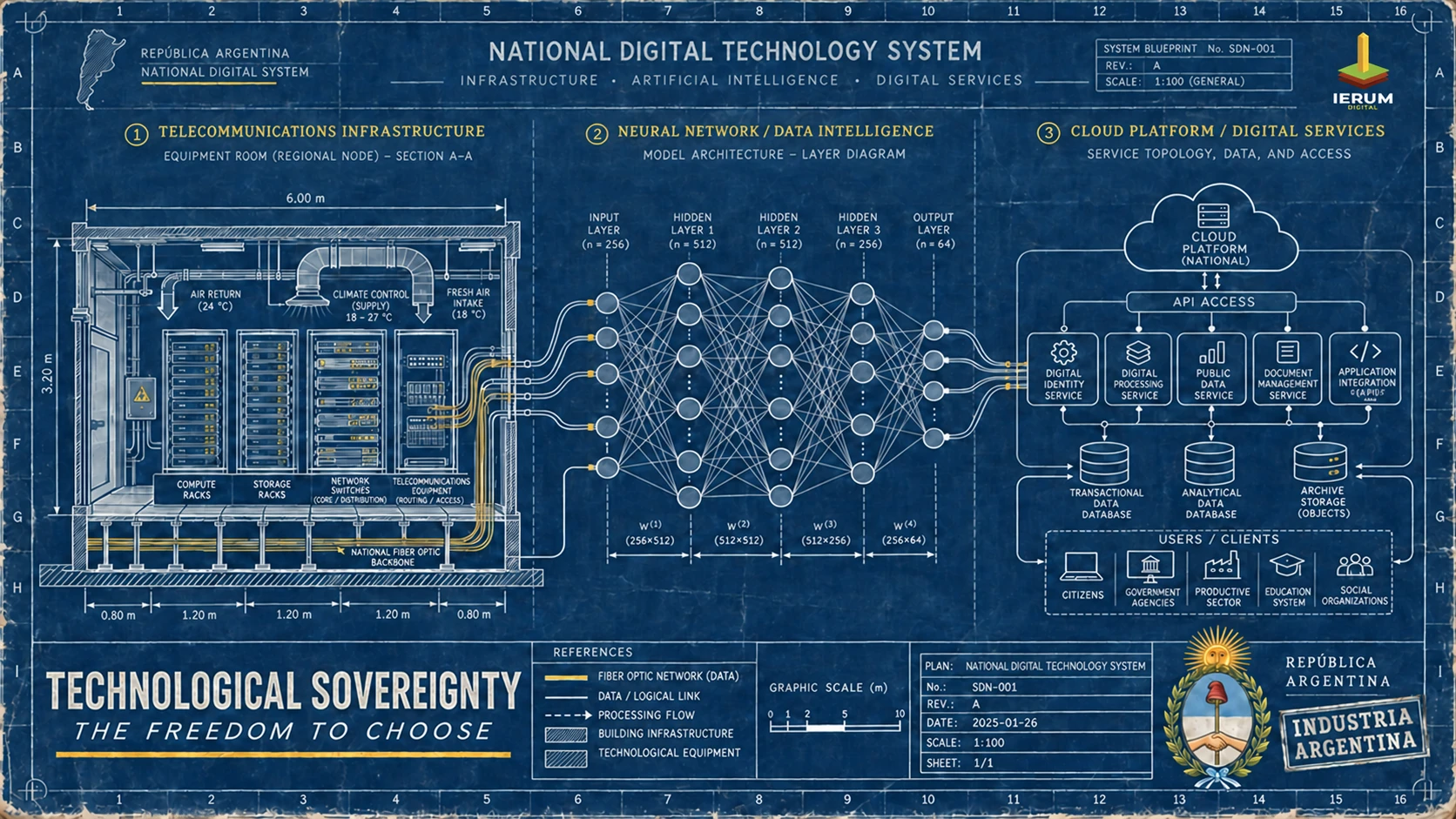
What happens if a technology that supports a critical operation suddenly becomes unavailable, changes its terms, or becomes too expensive?
We don't need to imagine an international conflict. It could be a contract change, an API that stops working, a price increase, or a commercial decision made beyond our control. In these situations, technological sovereignty stops being an abstract slogan: it becomes the ability to keep operating, understand the systems we use, and choose the tools we work with.
The freedom to choose without getting locked in
Framing sovereignty as a contest between Argentine and foreign products creates a false choice. Businesses and public institutions should be able to procure the best technology available, regardless of where it was developed. The problem begins when that choice is no longer reversible.
If we cannot retrieve our data in usable formats, audit a service, migrate our processes, or change vendors without rebuilding years of work, our freedom of choice is limited. Nor am I suggesting we develop everything from scratch: that would be expensive and, in many cases, unfeasible. Autonomy does not mean absolute self-sufficiency. It means having alternatives, expertise, and negotiating power.
Data is only one part of the picture
Hosting a server in Argentina does not automatically give an organization control over its systems. Access permissions, key management, licenses, documentation, data exports, and the ability to maintain a service when something fails matter just as much.
Artificial intelligence raises further questions: what data is sent, where it is processed, how long it is retained, whether it may be used to train models, and what happens when a provider changes or retires an API. Building systems that allow us to switch models, audit data flows, and keep institutional knowledge outside any single product can offer more practical autonomy than a declaration of sovereignty alone.
Legislation and contracts that preserve our options
Argentina has Personal Data Protection Law 25,326. Article 12 sets conditions for international transfers of personal data, including mechanisms and exceptions established by the applicable regulations. It is a starting point, but the technology debate also needs to address portability, interoperability, business continuity, and oversight of automated systems.
Not everything requires a new law. Many improvements can be incorporated into public procurement, standards, and verifiable contractual obligations: documented exports, exit plans, audits, and periodic recovery tests.
Poor regulation has costs too. Mandating local hosting indiscriminately could make operations more expensive and reduce choices without improving security. We need requirements proportionate to the risks involved, allowing organizations to operate globally without losing control over what matters most.
Infrastructure we can actually sustain
Digital infrastructure involves more than purchasing servers. It requires energy, connectivity, cybersecurity, maintenance, skilled people, and demand. In AI, computing capacity may be strategically important, but it is expensive and becomes obsolete quickly.
We do not need to replicate the entire infrastructure of major global providers. We do need to identify which critical uses—healthcare, research, education, public services, or other high-impact systems—justify domestic or regional capacity, access agreements, and continuity plans. The goal should not be to announce hardware purchases, but to secure specific capabilities with realistic operating costs.
Cooperation can build autonomy
Universities, research centers, companies, infrastructure providers, and governments can share knowledge, standards, and tools. Regional cooperation could spread investments that would be difficult to sustain independently.
Open-source software and interoperable formats make inspection, learning, and migration easier. But open does not automatically mean secure or maintainable: responsible teams, documentation, and funding are still essential. Sovereignty becomes tangible when people have the skills to operate, fix, and improve the technology they adopt.
An agenda for the next five years
If we want results, we should start by identifying critical dependencies, requiring portability in relevant contracts, distinguishing different levels of risk, building teams with operational expertise, and measuring verifiable outcomes: migration time, vendor concentration, continuity during incidents, and the sustained cost of alternatives.
The potential benefits are clear: greater resilience, stronger negotiating positions, locally developed expertise, and the ability to adapt. There are risks as well: investments that prove difficult to sustain, duplicated solutions, bureaucracy, and the protection of ineffective projects. Any serious policy must acknowledge both sides and adjust based on evidence.
A debate that belongs on the agenda
We can accept that immediate funding may not be available for everything. What we should not accept is for this discussion to be postponed indefinitely. Technological dependence becomes visible not only during crises, but also when a company no longer understands its own operations, cannot change vendors, or reduces every technology decision to purchasing another subscription.
That erosion affects organizations of every size. If it becomes widespread, it also limits our ability to train professionals, create knowledge, and participate in developing the technologies we use.
That is why every part of Argentina's technology sector should ask what role it can play: software developers, researchers, educators, technology buyers, and public policymakers. Not everyone can fund infrastructure, but everyone can help advance better standards, skills, and decisions.
We do not need to stop using foreign technology. We need to be able to decide when to use it and when our own interests call for an alternative. For that choice to be real, we must build the necessary capabilities before we urgently need them.
Technological sovereignty should not be a slogan for defending a closed industry. It should be a shared agenda that allows us to keep choosing.
Sources: Argentina's Law 25,326 · AAIP — International Data Transfers · UNCTAD — Investment in the Digital Economy.